

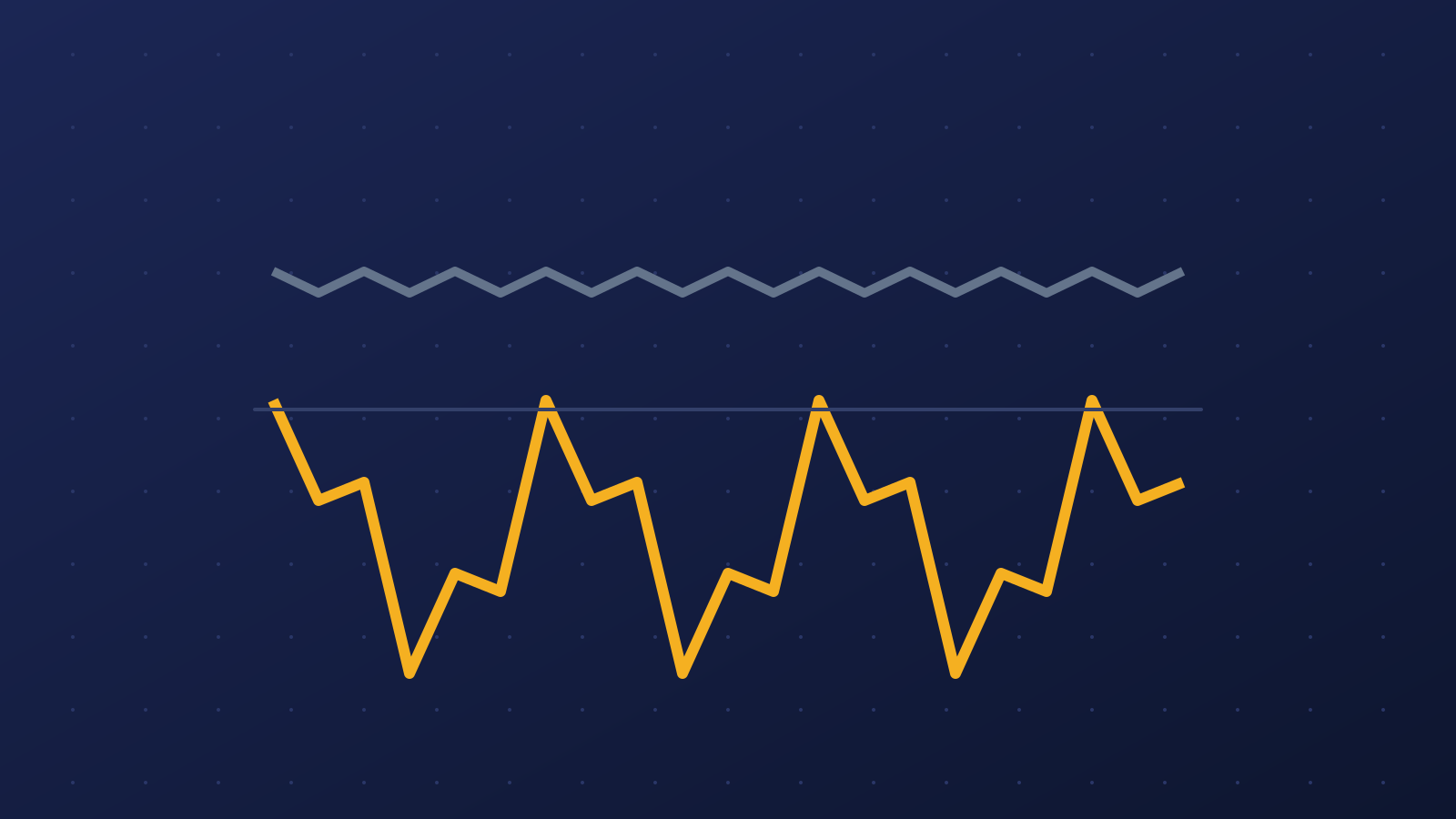
Every slot has two numbers that matter. RTP is the share of all stakes the game pays back over its lifetime. Volatility (also called variance) describes how lumpy those payments are: lots of small wins spread evenly, or long gaps broken by the occasional large one.
Put two games side by side at 96% RTP and they can still feel like different hobbies. One trickles back small amounts on a third of spins and drains slowly. The other returns very little for a long stretch, then pays heavily inside a bonus round that may or may not arrive while you are still playing.
The volatility bands
| Band | Share of spins that pay something | Usual top prize | How a session tends to go | Examples |
|---|---|---|---|---|
| Low | Roughly a quarter to a third | Up to around 1,000× | Frequent small wins, slow drift down | Starburst (500× max) |
| Medium | Roughly a fifth to a quarter | Around 1,000× to 5,000× | Some quiet patches, some lift | Fluffy Favourites, Rainbow Riches |
| High | Roughly one in six | 5,000× or more | Long dry runs, occasional big hits | Book of Dead, Big Bass Splash |
| Extreme | Often one in eight or fewer | 10,000× and beyond | Most sessions finish at nothing | Many Nolimit City and Hacksaw games |
Where volatility comes from
A slot's RTP is a fixed budget. If a game returns 96%, the designer has 96p of every pound staked to hand back, and the only question is how to hand it out. Spread it widely and you get a low volatility game. Concentrate it into rare events and you get a high one.
The tools are the paytable and the feature. A gentle game might pay 50× for its best symbol and hit on a third of spins. A harsh one might pay 500× for the top symbol, pay nothing on most spins and keep the bulk of its return inside a bonus round that triggers rarely.
| Band | Share of return paid in the base game | Share paid in features | Typical feature frequency |
|---|---|---|---|
| Low | About 70% to 85% | About 15% to 30% | Every 60 to 90 spins |
| Medium | About 50% to 70% | About 30% to 50% | Every 100 to 150 spins |
| High | About 30% to 50% | About 50% to 70% | Every 150 to 250 spins |
| Extreme | About 20% to 35% | About 65% to 80% | Every 250 to 400 spins |
Read the bottom row carefully. On an extreme game, most of what the slot will ever pay sits behind a door you may not open in an evening. A stingy base game is a design decision, because the money has been moved elsewhere.
Same RTP, very different evening
Picture £50 at 50p a spin on two games, both at 96%. On the low volatility slot you can expect to be still spinning after 150 spins, having collected dozens of small wins along the way. On the extreme one there is a fair chance the £50 has gone in under 80 spins with almost nothing back, and a smaller chance a single feature has paid £1,000.
Over millions of spins both games return the same 96%. Neither is kinder. What volatility decides is whether your particular £50 lasts the night, which is the question most players actually care about.
Judging the volatility of a game you have not played
- Look for a stated rating. Plenty of studios now print it in the help screen, often as a scale of one to five.
- Check the maximum win. This is the most dependable clue. A ceiling of a few hundred times stake points to low variance; five figures points to extreme, whatever the marketing claims.
- Note how often the feature lands. Free spins every 60 to 80 spins suggests a gentle game. If you are waiting 150 or more, it is high.
- Compare the top and bottom of the paytable. A flat spread (say 50× down to 2×) means steadier play. A top symbol at 500× with everything else under 5× means the game leans on one outcome.
Volatility and RTP are set by different people
The two figures are unrelated. A 94% slot can be gentle and a 97% slot can be brutal, so you need both to know what you are sitting down to.
There is also a practical difference in who controls them. Volatility is built in by the studio and stays the same wherever the game is hosted. RTP often comes in several versions, and the casino picks one. That makes RTP the figure to check every time you open a game. How to find the RTP a site is running.
Sizing your stake to the variance
A useful rule of thumb: have enough for at least 200 spins on a low volatility game, 300 on a medium one and 500 on a high one. With less than that, short-term swings decide your result far more than the RTP does.
| Bankroll | Low volatility stake | Medium | High volatility stake |
|---|---|---|---|
| £50 | 20p | 15p | 10p |
| £100 | 50p | 30p | 20p |
| £250 | £1 | 80p | 50p |
| £500 | £2 | £1.50 | £1 |
The stake cap you lose offshore. UK-licensed online slots carry a stake ceiling: £5 per spin if you are 25 or older, £2 if you are 18 to 24. That cap does not change a game's volatility, which the studio fixes, but it limits how fast variance can empty an account. Sites outside the UK often allow £100 or more a spin on the same games, so the brakes are yours to apply.
If you joined GamStop because gambling had become a problem, leave the exclusion in place. GamCare offers free, confidential support on 0808 8020 133.
A £200 session on three slots
Same budget, £1 stakes, all three games at 96% RTP:
| Low volatility | High volatility | Extreme volatility | |
|---|---|---|---|
| Typical spins before the money runs out | 400 or more | 200 to 250 | 100 to 150 |
| Finishing close to level | Fairly common | Less common | Rare |
| Finishing with nothing | Less common | Common | The usual result |
| Chance of a win over 100× | Very small | Moderate | Real |
| Middle outcome | A slow fall | Nothing left | Nothing left |
The last column is the one worth sitting with. The most likely single result on an extreme slot is a zero balance. The 96% average is propped up by rare, very large wins that most sessions never see. That is exactly what extreme volatility means, and it rarely appears in the game's promotional material.
Volatility when a bonus is attached
If you are working through a wagering requirement, high variance hurts twice. The balance is much more likely to hit zero before the playthrough is done, and the maximum bet rule stops you staking enough to finish quickly.
For clearing a bonus, a low volatility game is nearly always the better tool. Starburst turns up as the default free spins game on so many offers because its smooth payouts make the cost predictable for the casino, and that same predictability helps you. More in the wagering requirements guide.
Choosing a volatility on purpose
- Small budget, long evening? Pick low volatility. Big wins are unlikely, but you will still be playing an hour later.
- Chasing a large hit and comfortable that most sessions end at zero? High or extreme, with a stake small enough that a blank session is affordable.
- Working through a bonus? Low volatility. High variance is the main reason playthroughs fail.
- Undecided? Medium sits in the middle for good reason.
The costly mismatch is staking on an extreme game as if it were a gentle one. £100 at £2 a spin buys 50 spins on a title whose feature might average one in 300. The long-run maths never gets a look in.
Games by band
- Low: Starburst (500× max), Twin Spin, Blood Suckers.
- Medium: Fluffy Favourites, Rainbow Riches, Gonzo's Quest.
- High: Book of Dead (5,000× max), Big Bass Splash, Eye of Horus.
- Extreme: a large share of Nolimit City and Hacksaw releases, and most Megaways titles.
A thirty-second check before you spin
Open the paytable and find the maximum win. Below about 1,000× usually means low to medium. A ceiling in the 1,000× to 5,000× range suggests high. Past 10,000× is extreme, whatever adjective the game uses about itself.
On the same screen, read the RTP. You need both figures, and only the RTP can be changed by the casino. Read the RTP guide if you are unsure where to look.
Play with money you can afford to lose. Casino games are built to return less than is staked over time. Set a budget and use your account's deposit limits. Free, confidential support is available from GamCare on 0808 8020 133. More on staying in control.